By Keith Wong, FAR (BNM) · IFAR (BNM) · LFP (SC)
Your EPF nomination doesn’t necessarily override your will the way most people assume. Here’s the actual legal relationship between the two.
Table of Contents
EPF nomination vs will Malaysia comparisons usually assume the will decides who inherits EPF savings — it typically doesn’t. For non-Muslim members, EPF savings sit outside the deceased’s estate entirely, so a valid, current nomination pays out directly to the named nominee regardless of what the will says. For Muslim members, the nominee instead acts as an administrator (wasi) who must distribute the savings according to faraid (Islamic inheritance law), rather than keeping it personally unless they’re also a rightful heir.
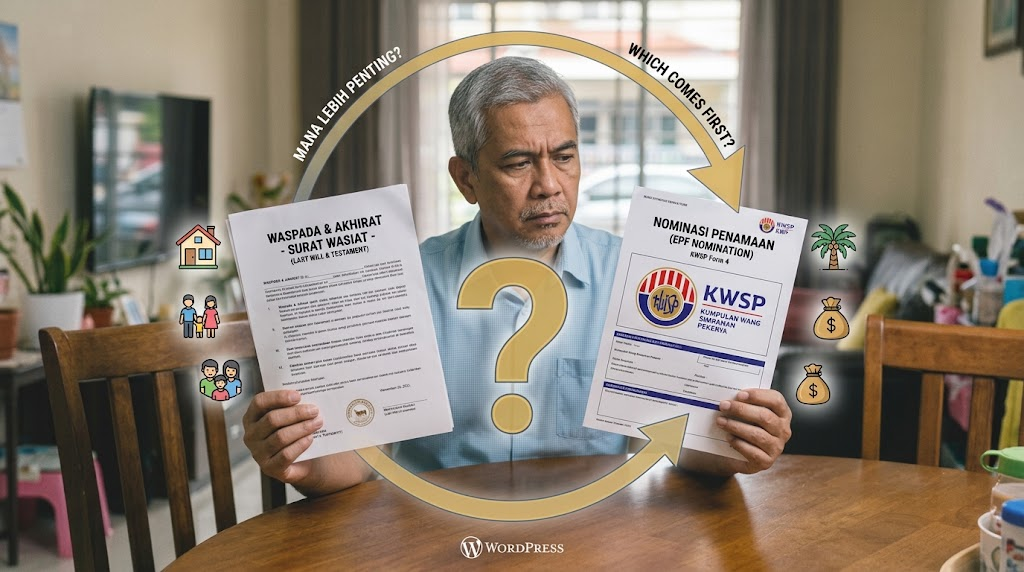
Most people assume a will is the master document — the one thing that decides who gets what when they pass away. It’s a reasonable assumption, and for most assets, it’s correct. But EPF savings are a specific exception, and the gap between what people assume and what actually happens is where a lot of family disputes and delays come from.
EPF Nomination vs Will Malaysia: Which One Actually Controls Your Savings?
The short answer is that your EPF nomination controls your EPF savings, not your will — and the reason is structural, not just procedural. Malaysian courts have confirmed that EPF contributions and accumulated dividends do not form part of a deceased member’s estate. Because a will only has authority over assets that form part of the estate, it simply has no jurisdiction over EPF savings when a valid nomination exists.
This surprises a lot of people, because the assumption is usually that nomination is just an administrative shortcut — a way to speed up payment while the will still decides actual entitlement. That’s not how it works for EPF. The nomination itself determines entitlement.
How Nomination Works for Non-Muslim Members
For non-Muslim members, a named nominee receives EPF savings as an absolute beneficiary — essentially an outright gift, not a fund they’re required to redistribute. If your will names a different person to receive “all my assets” or even specifically mentions your EPF account, that instruction generally won’t override a valid, current nomination. The nominee named with EPF gets the money directly.
How Nomination Works for Muslim Members
For Muslim members, the role of a nominee is different in a way that matters. The nominee acts as a wasi — an administrator — whose job is to receive the EPF savings and then distribute them to the rightful heirs according to faraid, Malaysia’s Islamic inheritance law. The wasi doesn’t personally keep the money unless they themselves are also entitled to a share under faraid. Muslim and non-Muslim members can both also choose to nominate Amanah Raya Berhad (ARB) instead of an individual — if selected, ARB becomes administrator to the member’s entire EPF balance.

Why “I’ll Just Update My Will” Doesn’t Cover Your EPF
Because a will and an EPF nomination are two entirely separate legal instruments, updating one does nothing to the other. Getting a new will drafted, or adding a codicil after a major life event, has no effect on who’s named as your EPF nominee — that record only changes when you actually update it directly with EPF. It’s a common and understandable mix-up, since most people think of “updating my estate planning” as a single task rather than several separate ones that each need attention.
Why Outdated Nominations Cause Real Problems for Families
An EPF nomination that was accurate five or ten years ago can quietly become a serious problem if it’s never revisited. A few situations that come up often:
- The named nominee has since passed away, and the member never updated the nomination — the family then has to go through the more complex process for a claim without a valid nomination
- An ex-spouse is still named as nominee after a divorce, and remains legally entitled to receive the payout directly unless the nomination is formally changed
- The nominee is a minor — the funds are held on trust (often by ARB) until the nominee turns 18, which can create cash-flow problems for a family that needed the money sooner
- Family members genuinely believe the will governs the EPF payout, only to discover after a death that a much older nomination — naming someone else entirely — takes precedence
Malaysian courts have also shown they’re reluctant to unwind a validly registered nomination after death without strong evidence, treating EPF’s role as a neutral trustee bound to pay the registered nominee. That finality is exactly why keeping the nomination current matters — a dispute after the fact is a difficult and often unsuccessful route.
How to Update or Make Your EPF Nomination
- Through the KWSP i-Akaun mobile app, with identity verification completed via e-KYC — no branch visit required
- Through the i-Akaun member web portal
- By submitting a physical KWSP Form 4 at any EPF branch
- EPF recommends nominating immediate family — a spouse, children, or parents — and reviewing the nomination after any major life event: marriage, divorce, a new child, or the death of an existing nominee
Frequently Asked Questions
Does updating my will automatically update my EPF nomination?
No. They’re two separate legal instruments administered through completely different processes. Updating your will has no effect on your EPF nomination, and vice versa — both need to be reviewed and updated independently.
What happens if I have no EPF nomination at all?
Without a valid nomination, your family cannot claim your EPF savings directly. They’ll typically need to go through the death withdrawal process for members without nomination, which usually requires proof of entitlement through a Grant of Probate, Letters of Administration, or a Distribution Order — a slower and more involved process than a straightforward nominee payout.
Can my EPF nomination be legally challenged after I pass away?
It can be challenged, but Malaysian courts have generally been reluctant to overturn a validly registered nomination without strong, specific evidence of fraud or incapacity at the time it was made. Family disagreement or disappointment alone is typically not enough to unsettle a valid nomination.
Should I still bother making a will if my EPF nomination already covers those savings?
Yes. Your will still governs everything that does form part of your estate — property, bank accounts, business interests and other assets your EPF nomination doesn’t touch. Treating your will and your EPF nomination as two separate documents that both need to stay current is the safer approach, rather than assuming one covers the other.
If you’re not sure whether your EPF nomination still reflects your actual wishes — or how it fits together with your will and broader estate plan — I can help you look at the whole picture.
WhatsApp me at +6016-336 9321 and we’ll go through your current nominations together.
This article is for general information only and does not constitute legal or estate planning advice. Nomination rules, procedures and legal interpretations are subject to change and may vary by individual circumstance. Please consult a licensed financial adviser or estate planning lawyer before making decisions about your EPF nomination or will.