By Keith Wong, FAR (BNM) · IFAR (BNM) · LFP (SC)
A regional or global benefits template rarely fits Malaysia’s regulatory and market reality without adjustment. Here’s what typically needs localising.
Table of Contents
MNC employee benefits Malaysia subsidiary planning almost always needs local adjustment, because a regional or global template is built around statutory minimums, medical norms and cost structures that don’t match Malaysia’s. Malaysian statutory contributions (EPF, SOCSO, EIS, HRDF) are non-negotiable and sit outside most global benefits frameworks, local market norms around outpatient and dental coverage differ from what a template usually assumes, and a mixed Muslim/non-Muslim workforce raises Takaful considerations that a purely conventional-insurance template won’t account for.
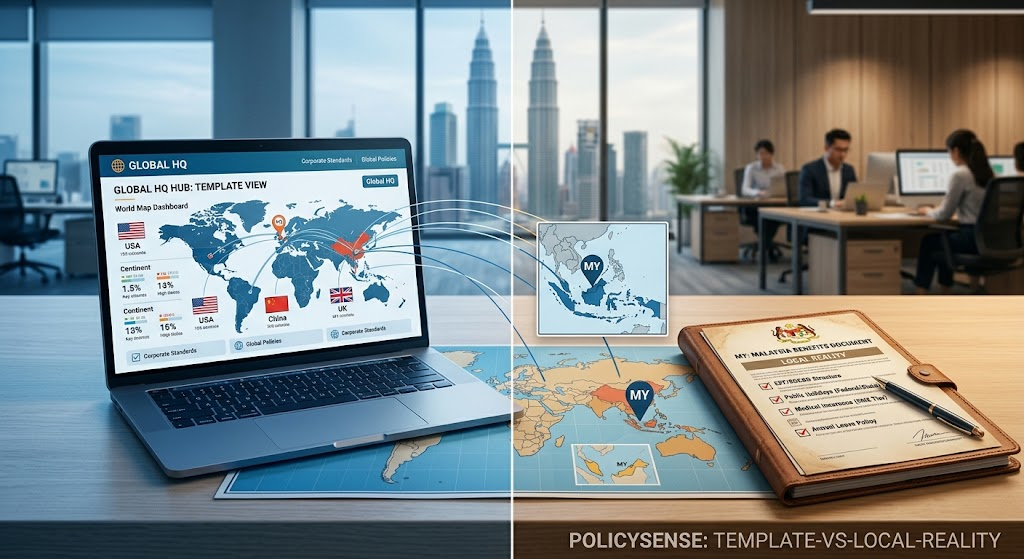
When a multinational corporation (MNC) sets up or expands a Malaysian subsidiary, HR is often handed a regional or global benefits framework and asked to “roll it out locally.” On paper that sounds efficient — one template, one administration layer, consistent employee experience across markets. In practice, Malaysia has enough regulatory and market-specific quirks that a template applied without adjustment usually creates gaps, some of which are compliance issues and not just employee experience issues.
MNC Employee Benefits Malaysia Subsidiary: Why the Template Rarely Fits As-Is
Most regional benefits templates are built around whichever market the framework originated in — often Singapore, Hong Kong, or a headquarters market in Europe or the US. Those markets have different statutory contribution structures, different private medical insurance norms, and in most cases a religiously homogeneous or non-Islamic-finance-relevant workforce. Malaysia differs on all three counts, and each difference has real cost and compliance implications if it’s missed rather than deliberately localised.
The Non-Negotiable Malaysian Statutory Minimums
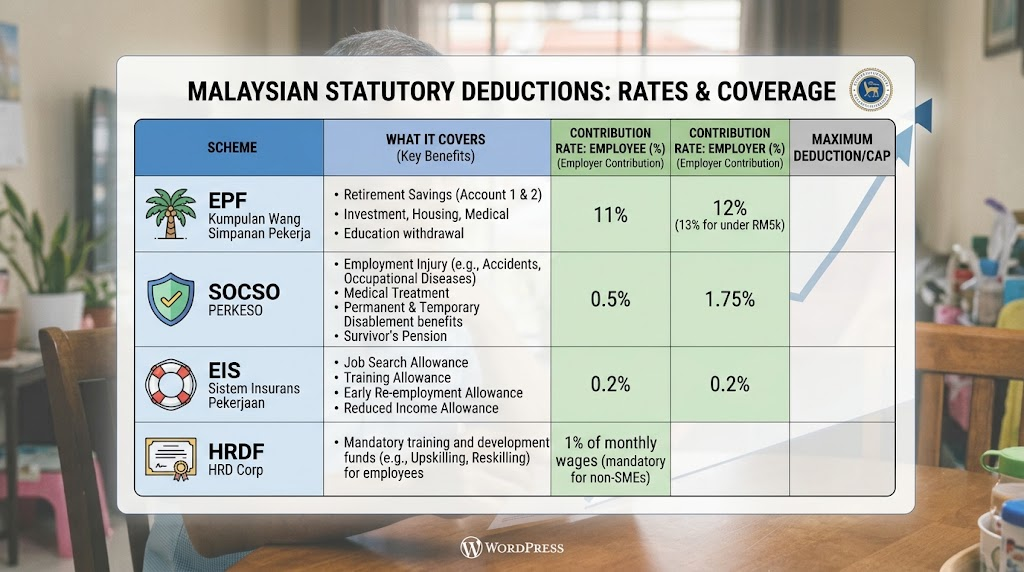
Before any supplementary benefits design even starts, four statutory contributions apply to Malaysian employees regardless of what the global template says:
- EPF (Employees Provident Fund) — the standard employer contribution is 13% of monthly wages for salaries up to RM5,000, and 12% above that, with employees contributing 11%. This is Malaysia’s core retirement savings scheme and functions very differently from a defined-contribution pension plan a template might assume.
- SOCSO (PERKESO) — covers employment injury and invalidity, calculated against a monthly wage ceiling of RM6,000.
- EIS (Employment Insurance System) — a smaller 0.2% employer and 0.2% employee contribution that funds retrenchment benefits.
- HRDF (HRD Corp levy) — mandatory at 1% of monthly payroll for employers with 10 or more Malaysian employees in most industries, funding employee training.
Foreign workers were also brought into mandatory EPF from October 2025, at a lower 2% employer and 2% employee rate — a detail that regularly gets missed in a template built before that change, and one worth flagging specifically if the subsidiary employs foreign nationals.
Where Local Market Norms Diverge From a Global Template
Even after statutory minimums are handled, the supplementary benefits layer usually needs adjusting too. A few of the most common gaps:
- Outpatient coverage — Malaysian employees typically expect outpatient GP and specialist visits to be covered as a matter of course; a template built around a market where outpatient care is state-funded or bundled differently can leave this out entirely.
- Dental and optical — often treated as a baseline expectation in the local market even when a global template treats them as a premium add-on.
- Maternity and parental leave — Malaysian statutory maternity leave and any enhanced parental benefits need to be checked against what the template assumes, since leave entitlements vary significantly by market.
- Group hospitalisation and surgical (H&S) design — annual limits, room and board caps, and panel hospital networks that make sense in one market can be poorly calibrated for Malaysian private hospital costs and medical inflation trends.
- Group term life and disability — sums assured that were set against another market’s salary bands and cost of living often need rescaling for Malaysia rather than being applied as a flat multiple.
Takaful Considerations for a Mixed Workforce
A workforce split between Muslim and non-Muslim employees is a factor that most global or regional benefits templates simply don’t address, because it isn’t relevant in the markets those templates were originally designed for. For an MNC employee benefits Malaysia subsidiary structure, it’s worth considering upfront rather than retrofitting later.
Takaful products are structured on Shariah-compliant principles of mutual protection and shared risk, as an alternative to conventional insurance. Some Malaysian employers offer Takaful-based group medical and life coverage as either the default or an opt-in alternative, particularly where a meaningful share of the workforce would prefer it. This doesn’t have to mean running two entirely separate benefits programmes — several insurers offer Takaful and conventional versions of the same underlying product structure, which keeps the coverage broadly consistent while giving employees a choice that fits their preference.
A Practical Localisation Checklist
- Confirm all four statutory contributions (EPF, SOCSO, EIS, HRDF) are correctly built into the cost model — these sit outside most global benefits budgets and are easy to under-provision for
- Benchmark the supplementary medical, dental and optical package against local market norms, not just against what the template includes elsewhere
- Check group life and disability sums assured are rescaled to Malaysian salary levels and cost of living, not carried over as a flat regional multiple
- Decide whether to offer a Takaful option for group medical and life coverage, particularly for a workforce with a meaningful Muslim employee base
- Review maternity, paternity and other leave-linked benefits against Malaysian statutory minimums and common local market practice
- Confirm the subsidiary’s headcount and industry classification for HRDF applicability, since this is often missed for smaller or newly established entities
Frequently Asked Questions
Can a multinational just extend its global insurer’s policy to cover the Malaysian subsidiary?
Sometimes, if the insurer has local licensing and a Malaysian-admitted policy, but not always — Malaysian insurance regulation generally requires locally licensed coverage for locally employed staff, so this needs to be confirmed with the insurer or a local adviser rather than assumed.
Is Takaful mandatory for Malaysian employee benefits?
No. Takaful is an option, not a requirement — employers can offer conventional insurance, Takaful, or both, and the right choice depends on the composition and preference of the workforce rather than any regulatory mandate.
How much does statutory compliance typically add to the cost of a Malaysian benefits package, on top of supplementary insurance?
It varies by salary structure and headcount, but EPF alone typically adds 12-13% of payroll on the employer side, with SOCSO, EIS and HRDF adding a further percentage on top — a meaningful cost layer that’s easy to underestimate if a regional cost model doesn’t already account for it.
Do foreign employees working in the Malaysian subsidiary need to be included in EPF?
As of October 2025, eligible foreign workers are included in mandatory EPF at a lower 2% employer and 2% employee rate, alongside standard SOCSO coverage — a relatively recent change that’s worth double-checking against the subsidiary’s specific workforce.
If you’re localising or reviewing a multinational benefits framework for a Malaysian subsidiary, I can help you work through what’s statutory, what’s market norm, and where Takaful might be worth building in.
WhatsApp me at +6016-336 9321 and we can go through your current structure together.
This article is for general information only and does not constitute financial, insurance or legal advice. Statutory rates, regulatory requirements and product availability are subject to change. Please consult a licensed financial adviser or employment law specialist before finalising any employee benefits structure.