By Keith Wong, FAR (BNM) · IFAR (BNM) · LFP (SC)
Table of Contents
Quick Answer:
If you’re weighing insurance in your 50s Malaysia what to buy, prioritise your medical card and critical illness cover first. Both get sharply more expensive once you cross into your 50s, and several insurers stop accepting new applicants past a certain entry age altogether — so the real cost of waiting isn’t just a higher premium, it’s losing the option to buy at all.
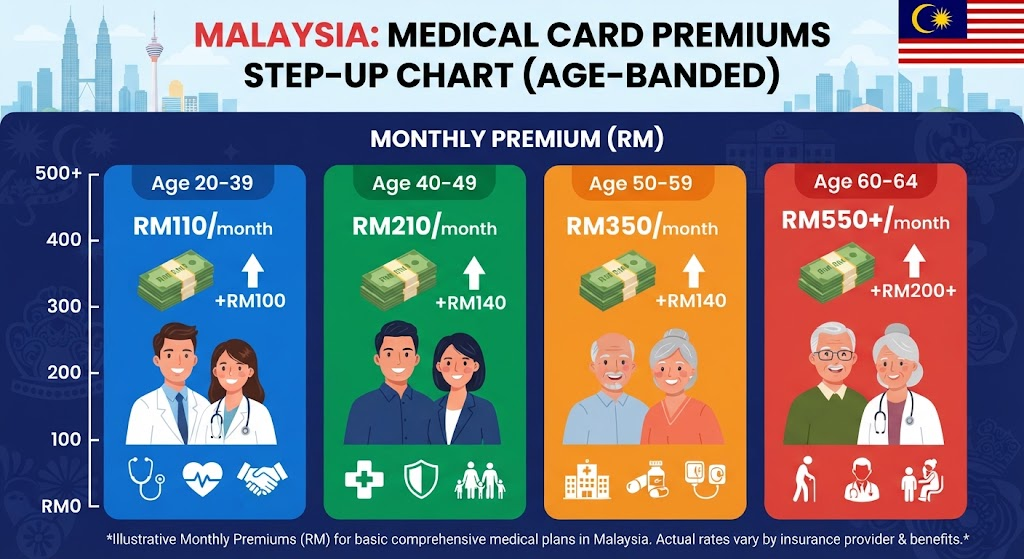
Your 50s are a quiet but critical decade for insurance planning. Nothing dramatic forces the issue the way a new baby or a first mortgage does in your 30s — which is exactly why so many people drift through this decade without reviewing their coverage, until a premium renewal notice or a health scare forces the question. Working out insurance in your 50s Malaysia what to buy now, while you likely still qualify, is worth doing deliberately rather than reactively.
Why Premiums Jump So Much After 50
Medical and health insurance in Malaysia is priced in age bands, and the bands get steeper as you get older because claims frequency rises with age — it’s not arbitrary, it reflects actual claims data across the insurer’s whole book. A jump from your 40s band into your 50s band is typically far larger than the jump from your 30s into your 40s. Critical illness riders follow the same logic, since conditions like cancer, heart disease, and stroke — the core covered illnesses — become statistically far more common past 50.
This is also the decade where a claims history starts to matter more. If you’ve made any claims in your 40s, renewal terms on some products can tighten (loadings, exclusions for the claimed condition) even without a full new-application review — another reason to lock in broader cover while your history is still clean.
Insurance in Your 50s Malaysia What to Buy First
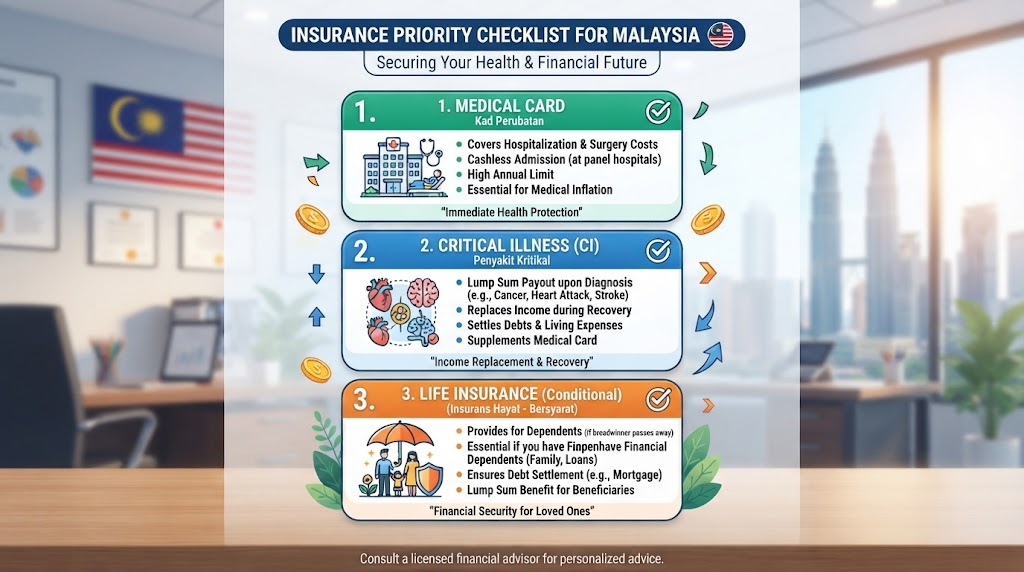
Not every product deserves equal urgency. If you’re prioritising insurance in your 50s Malaysia what to buy against a limited budget, this is roughly the order that matters most, based on what becomes hardest to get later versus what you can still add cheaply in your 60s.
1. Medical Card / Health Insurance
This is the single most urgent one to lock in now. Entry-age cutoffs (commonly around 60-65 depending on the insurer) mean that once you cross that line, you may not be able to buy a new medical card at all, regardless of budget — pre-existing conditions by then make it even harder. If you don’t already have a standalone medical card, this decade is the last comfortable window to get one underwritten.
2. Critical Illness Cover
A critical illness payout gives you a lump sum on diagnosis of a covered condition, which can cover income loss, treatment not covered by your medical card, or debt repayment while you recover. Premiums rise fast in this age band and coverage caps often shrink at older entry ages, so topping this up now is usually cheaper than doing it at 58 or 60.
3. Life Insurance (Only If Someone Still Depends on Your Income)
If your children are financially independent and your mortgage is paid off or close to it, new life insurance is usually a lower priority in your 50s — the human life value case for it has typically shrunk. If you’re still supporting dependents, still carrying business debt, or a business partner relies on a keyman policy, this stays a priority alongside medical and critical illness cover, not instead of them.
Entry-Age Cutoffs: You’re Not Just Losing Price, You’re Losing the Option
The mistake I see most often isn’t people picking the wrong product — it’s people delaying the decision because “the premium feels expensive right now,” without realising that price is not the only thing changing. Most insurers set a maximum entry age for new applications, separate from the maximum age they’ll continue covering existing policyholders. Once you’re past that entry age, no amount of budget fixes it — you simply can’t buy that product new anymore. Reviewing this in your early-to-mid 50s, rather than waiting until 58 or 59, gives you room to actually shop and compare, instead of scrambling to get anything approved before a cutoff closes.
If You’re a Business Owner Nearing Exit Age
This decade often overlaps with planning a business exit or succession, which adds a layer most personal-finance advice skips. If you’re a business owner, this is worth reviewing alongside your personal cover: a keyman policy on yourself, whether a buy-sell agreement is funded by insurance rather than assumed goodwill, and whether your group medical and life benefits (if you’re on your own company’s group scheme) will actually continue once you step back from day-to-day operations. None of this fixes itself automatically at exit — it needs the same deliberate review as your personal medical card and critical illness cover.
Frequently Asked Questions
Is it too late to buy medical insurance at 55?
Usually not, but it depends on the insurer’s specific entry-age cutoff and your health at underwriting. It gets harder and more expensive the longer you wait, and some products will no longer be open to you at all past a certain age — so 55 is a better time to apply than 58.
Should I keep my old policies or replace them with new ones?
Generally keep existing policies rather than cancelling and rebuying, since a new application means fresh underwriting and new waiting periods on pre-existing conditions. Review for gaps and top up separately, rather than replacing what you already have.
Does my employer’s group insurance cover me enough in my 50s?
Group coverage is useful but usually capped and disappears the moment you leave the job or retire. If it’s your only medical cover, that’s a gap worth closing with a personal policy before you’re no longer employed and lose group eligibility.
Not Sure What Gaps You Actually Have?
I can review your existing policies against your current age band and flag what’s worth locking in now versus what can wait. WhatsApp me at +6016-336 9321 for a policy review.
Disclaimer: This article is for general informational purposes only and does not constitute financial or insurance advice. Entry-age cutoffs, underwriting requirements, and premium bands vary by insurer and product — always review actual policy terms before purchasing. Keith Wong is a Financial Adviser’s Representative (FAR) and Islamic Financial Adviser’s Representative (IFAR) licensed under Bank Negara Malaysia, and a Licensed Financial Planner (LFP) under the Securities Commission Malaysia.