By Keith Wong, FAR (BNM) · IFAR (BNM) · LFP (SC)
Table of Contents
Quick Answer:
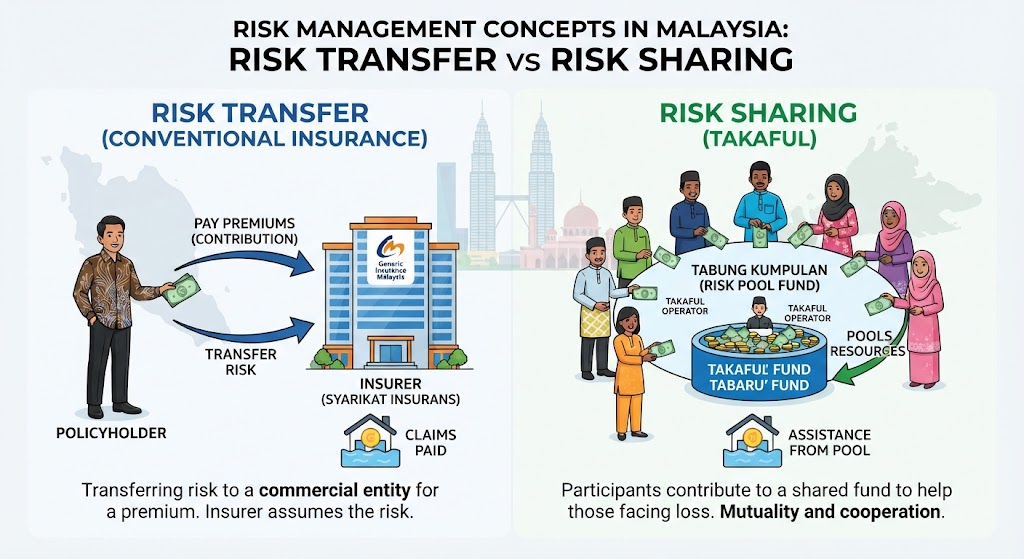
The takaful vs conventional insurance Malaysia difference comes down to the contract, not the coverage. Conventional insurance is a risk-transfer contract — you pay a premium, and the insurer takes on your risk in exchange. Takaful is a risk-sharing contract — participants pool money into a fund (tabarru’) and mutually agree to help each other from that fund when a claim happens. Day-to-day, the benefits often look almost identical. The legal and religious basis underneath does not.
Most people shopping for a medical card or life cover in Malaysia eventually hit the same fork: takaful or conventional? The marketing brochures make both sound reassuring and the benefit tables often look nearly identical line for line, which makes the decision feel arbitrary. It isn’t. Understanding the takaful vs conventional insurance Malaysia difference at the contract level is the only way to actually compare the two products intelligently — rather than just picking whichever one your agent pushes first.
What Conventional Insurance Actually Is
A conventional insurance policy is, legally, a contract of risk transfer. You pay a premium to the insurer. In exchange, the insurer agrees to absorb a defined risk — a hospital bill, a death benefit, a fire claim — and pays it out of its own capital and reserves when a covered event occurs. The insurer prices the premium to cover expected claims across its whole pool of policyholders, plus its own costs and profit margin. Once you’ve paid the premium, the risk is legally the insurer’s problem, not yours.
This is a straightforward buyer-seller relationship. You’re not a part-owner of the fund your premium sits in, and you have no claim on the insurer’s profits beyond what your policy contractually promises.
What Takaful Actually Is: Risk-Sharing Through Tabarru’
Takaful works on a fundamentally different contract basis, rooted in Shariah principles that prohibit riba (interest), gharar (excessive uncertainty), and maysir (gambling) in the conventional insurance structure. Instead of transferring risk to an insurer, takaful participants agree to mutually guarantee each other.
The Tabarru’ Contribution
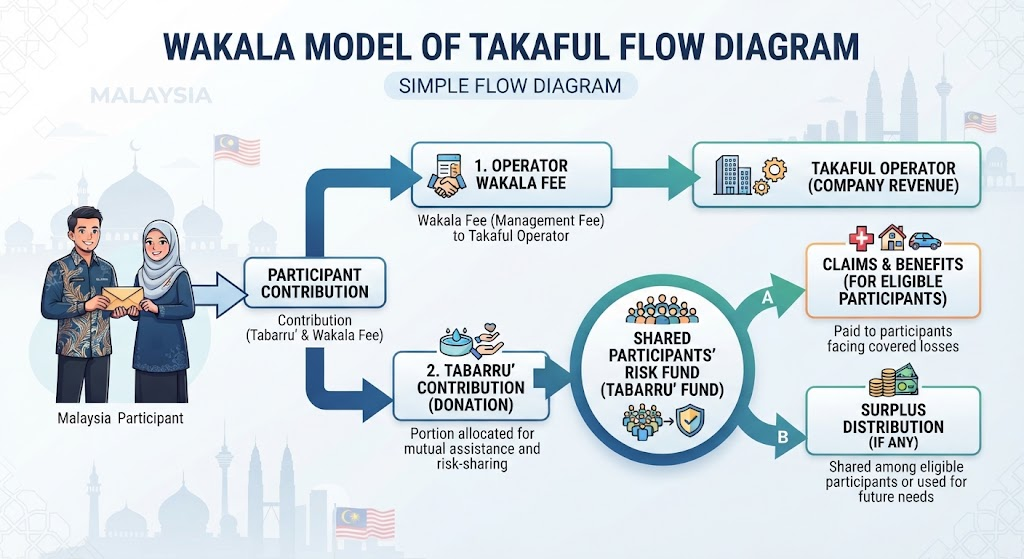
When you pay a takaful contribution, part of it is treated as tabarru’ — a donation you make into a shared participants’ risk fund (PRF), on the basis that you’re helping fellow participants who may claim, with the understanding that others will do the same for you. The takaful operator doesn’t own this fund. It manages the fund on behalf of participants, typically under a wakalah (agency fee) model, a mudarabah (profit-sharing) model, or a hybrid of both, and is paid a fee or share for that management role — not for taking on your risk directly.
Wakalah, Mudarabah, and Hybrid Models
Under wakalah, the operator charges an upfront agency fee for running the fund and processing claims. Under mudarabah, the operator instead takes a share of any investment profit the fund generates. Most Malaysian takaful operators today run a hybrid: wakalah for underwriting and management, mudarabah (or a wakalah-based incentive fee) for investment performance. Either way, the operator’s income is structured as a fee for service, not as ownership of your risk contribution.
The Takaful vs Conventional Insurance Malaysia Difference in Practice
Here’s the part that surprises most people: for a straightforward medical card or term life plan, the takaful vs conventional insurance Malaysia difference rarely shows up in your day-to-day experience. Both are regulated by Bank Negara Malaysia. Both go through underwriting, medical questions, waiting periods, and claims processes that look almost identical from the participant’s side. A takaful medical card and a conventional medical card from the same insurer group often cover the same panel of hospitals, the same room-and-board limits, and the same exclusions — because the underlying claims risk being priced is the same, regardless of the contract structure behind it.
The real differences show up in three places: the contract basis itself (relevant if Shariah compliance matters to you religiously or as a matter of principle), how any surplus is handled, and — in rare cases — what happens if the operator becomes insolvent, since a participants’ risk fund is structurally ring-fenced from the operator’s own balance sheet in a way a conventional insurer’s general fund isn’t.
Surplus Sharing: The One Real Financial Difference
This is usually the most tangible difference for a participant. If the participants’ risk fund has more money left over at the end of the period than it paid out in claims, that surplus doesn’t automatically become the operator’s profit. Depending on the plan’s terms, some or all of it can be distributed back to participants who didn’t claim, or rolled over to strengthen the fund. A conventional insurer, by contrast, keeps its underwriting profit — you don’t get a share of it just because you didn’t claim during the year, beyond whatever no-claim discount your policy contractually offers.
Which One Should You Actually Choose?
If Shariah compliance is a requirement for you — for religious reasons or because you want to avoid riba and gharar structures on principle — takaful is the only option that fits, and the choice is straightforward. If that’s not a factor, once you understand the takaful vs conventional insurance Malaysia difference, the decision usually comes down to comparing the actual policy terms in front of you: premiums or contributions, coverage limits, panel hospitals, exclusions, and insurer/operator track record on claims — rather than the contract label. In practice, I compare both side by side for clients rather than assuming one is automatically better, because pricing and benefit design vary more between specific products than between takaful and conventional as categories.

Frequently Asked Questions
Is takaful only for Muslims?
No. Takaful is open to participants of any religion in Malaysia. Many non-Muslim Malaysians choose takaful products simply because the terms, pricing, or surplus-sharing structure suit them, not for religious reasons.
Are takaful premiums cheaper than conventional insurance?
Not automatically. Pricing depends on the specific product, the operator’s claims experience, and the risk being covered — not on whether it’s structured as takaful or conventional. You need to compare actual quotes, not assume one category is cheaper.
Does Bank Negara Malaysia regulate takaful the same way as insurance?
Yes. Takaful operators are licensed and supervised by Bank Negara Malaysia under the Islamic Financial Services Act 2013, with Shariah governance requirements on top of the standard prudential rules that apply to conventional insurers.
Can I switch from conventional insurance to takaful, or the other way around?
You can apply for a new takaful or conventional policy at any time, but switching isn’t a simple conversion — you’ll go through fresh underwriting, and any pre-existing conditions or waiting periods on the new policy start over. It’s worth reviewing this with an adviser before cancelling an existing policy.
Not Sure Which Fits Your Situation?
I’m licensed under Bank Negara Malaysia for both conventional insurance (FAR) and takaful (IFAR), so I can compare both side by side for your actual situation — not just push whichever one I’m limited to selling. WhatsApp me at +6016-336 9321 to talk it through.
Disclaimer: This article is for general informational purposes only and does not constitute financial, insurance, or Shariah advice. Product terms vary by insurer and takaful operator — always review the actual policy document and terms before purchasing. Keith Wong is a Financial Adviser’s Representative (FAR) and Islamic Financial Adviser’s Representative (IFAR) licensed under Bank Negara Malaysia, and a Licensed Financial Planner (LFP) under the Securities Commission Malaysia.
1 thought on “Takaful vs Conventional Insurance: The Actual Contractual Difference”