Dying without a will in Malaysia rarely leads to the outcome you’d actually want — here’s the straightforward version of what really happens.
By Keith Wong, FAR (BNM) · IFAR (BNM) · LFP (SC)
Table of Contents
Quick Answer: What happens if you die without a will in Malaysia comes down to one core fact: your estate is distributed according to the Distribution Act 1958 — not according to your own wishes. A court-appointed administrator (not an executor you chose) handles the estate, distribution follows fixed formulas based on your surviving relatives, and the whole process is typically slower and more expensive than a straightforward will-based estate would be.

What Happens If You Die Without a Will in Malaysia
Most people assume that without a will, their spouse or children will simply inherit everything, or that the government somehow takes over. Neither is accurate. Dying without a will in Malaysia is governed specifically by the Distribution Act 1958 (for non-Muslims; Muslim estates follow Faraid law instead), which sets out fixed formulas for how an estate is divided among surviving relatives, based purely on their relationship to you — not on what you would have actually wanted.
This means your estate could end up split in ways you never intended — for example, a surviving spouse doesn’t automatically inherit the entire estate if there are also surviving parents or children; the Act divides the estate between them according to a fixed ratio, regardless of your actual relationship dynamics or financial dependents.
How Distribution Act 1958 Formulas Actually Divide an Estate
The exact split depends on which combination of relatives survive you. A few common scenarios:
- Spouse and children survive: the estate is typically divided between the spouse and children according to a fixed ratio — the spouse does not automatically receive everything.
- Spouse and parents survive, no children: the estate is divided between the spouse and surviving parents.
- No spouse, children survive: the estate passes to the children in equal shares, regardless of their individual needs, ages, or circumstances.
- No spouse, no children, parents survive: the estate passes to the parents.
- No immediate family survives: the Act continues down a hierarchy of relatives — siblings, grandparents, and so on — before an estate with genuinely no traceable relatives is dealt with by the state.
None of these formulas account for a blended family, a long-term partner you weren’t legally married to, a specific child who needs more support than the others, or a charity or cause you wanted to include. If your actual wishes differ from this formula in any way — and for most people, they do — a will is the only way to override it.
Who Handles the Estate Without a Will
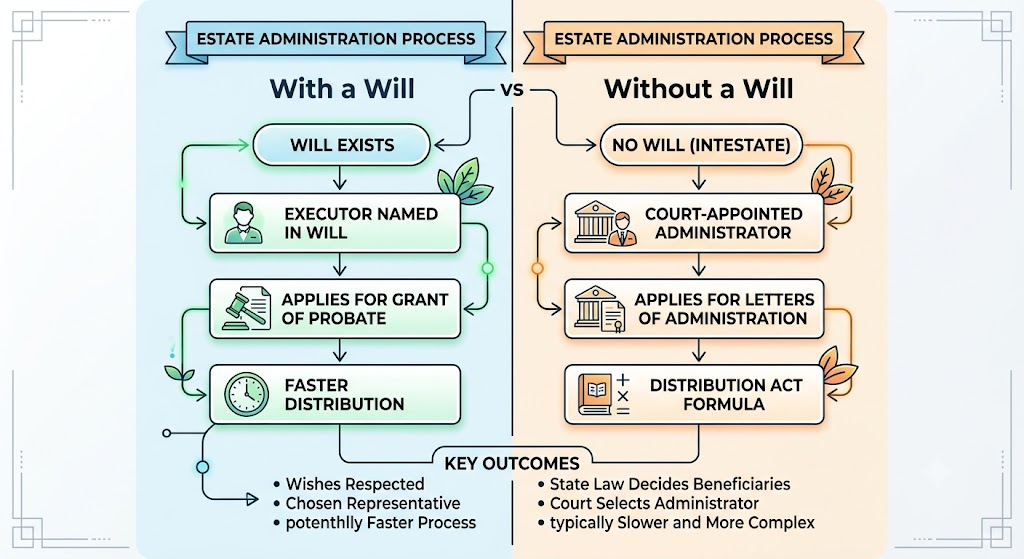
With a valid will, you name your own executor — someone you trust to carry out your instructions. Without one, the court appoints an administrator instead, usually a close relative who applies for Letters of Administration. This isn’t automatic or immediate: the application process itself can take months, during which bank accounts may be frozen, property transactions can’t proceed, and dependents may not have access to funds they were counting on.
Why this matters for cash flow, not just fairness
Families sometimes assume the practical impact of dying without a will is limited to “who gets what.” In practice, the bigger day-to-day issue is often the delay: a surviving spouse or child needing access to funds for daily expenses, school fees, or mortgage payments while the estate sits in administration limbo is a real and common problem, not a hypothetical one.
The Delay and Cost Implications for the Family
Beyond the emotional difficulty of losing a family member, intestate estates typically involve more legal cost and more time than a straightforward will-based estate — legal fees for the Letters of Administration application, potential disputes between relatives over who should be the administrator, and the general slowdown of dealing with a court process rather than a private document. For a family already dealing with grief, this added friction is one of the more preventable sources of stress in the entire process.
Writing a Will Doesn’t Have to Be Complicated
A basic will covering straightforward personal assets doesn’t require an elaborate process — the barrier for most people isn’t complexity, it’s simply never getting around to it. What it does require is naming an executor you trust, being specific about how you want assets divided (rather than leaving it to a default formula that may not reflect your actual wishes), and keeping the will updated after major life events like marriage, divorce, or having children, since an outdated will can create its own complications.

Frequently Asked Questions
Does my spouse automatically inherit everything if I die without a will in Malaysia?
No. Under the Distribution Act 1958, a surviving spouse’s share depends on which other relatives (children, parents) also survive — the spouse does not automatically receive the entire estate in most scenarios.
Does the Distribution Act apply to Muslims in Malaysia?
No. Muslim estates in Malaysia are governed by Faraid law instead of the Distribution Act 1958. The distribution formulas and process differ significantly from what’s described here.
How long does it take to distribute an estate without a will?
It varies by case complexity, but applying for Letters of Administration and completing distribution typically takes considerably longer than executing a straightforward will — often many months, particularly if there’s any dispute over who should administer the estate.
Can I write my own will without a lawyer in Malaysia?
It’s possible for simple estates, but a will needs to meet specific legal requirements (proper execution, witnessing, and capacity) to be valid. Given how much is at stake if it’s later challenged or found invalid, working with a qualified professional is generally worth the cost for anything beyond the most basic estate.
Haven’t written a will yet?
Now that you know what happens if you die without a will in Malaysia, WhatsApp Keith Wong at +6016-336 9321 to talk through your estate planning options before it becomes your family’s problem to solve.
Disclaimer: This article is for general informational purposes only and does not constitute legal advice. Estate distribution rules, will validity requirements, and Faraid application differ by individual circumstance and religion. Please consult a qualified lawyer or your appointed Financial Adviser’s Representative for guidance specific to your situation.