Both build retirement savings, but they’re not interchangeable — here’s what actually separates PRS from EPF, and who genuinely benefits from having both.
By Keith Wong, FAR (BNM) · IFAR (BNM) · LFP (SC)
Table of Contents
Quick Answer: The PRS vs EPF Malaysia difference comes down to structure and purpose: EPF is mandatory, employer-and-employee funded, and covers all salaried Malaysians by default. PRS is voluntary, self-directed, and exists specifically to fill gaps EPF doesn’t cover — for the self-employed with no EPF at all, or for anyone whose EPF savings alone won’t be enough for the retirement they actually want. Most people don’t need to choose between them; the real question is whether your EPF alone is on track, and if not, whether PRS is the right way to close that gap.

EPF: Mandatory, Structured, and the Default for Most Malaysians
The Employees Provident Fund (EPF) is Malaysia’s mandatory retirement savings scheme for salaried employees. Both employer and employee contribute a fixed percentage of monthly salary, the fund is managed by EPF itself with a guaranteed minimum dividend, and withdrawal is restricted until retirement age (with some exceptions for housing, education, and medical needs). For most salaried Malaysians, EPF is the automatic foundation of retirement savings — you don’t choose to have it, it’s simply part of employment.
The self-employed, freelancers, and business owners don’t have this default. Unless they opt into EPF’s self-contribution scheme, there’s no mandatory retirement savings mechanism attached to their income at all — which is exactly the gap PRS was designed to address.
PRS: Voluntary, Flexible, and Fund-Choice Driven
The Private Retirement Scheme (PRS) is a voluntary, privately managed retirement savings scheme regulated by the Securities Commission Malaysia. Unlike EPF, there’s no employer contribution by default, no fixed contribution percentage, and no single fund — you choose your own PRS provider and fund mix (conservative, moderate, or growth-oriented funds) based on your own risk appetite and retirement timeline.
This flexibility is both PRS’s main advantage and its main risk: your PRS returns depend on the fund you pick and how it performs, unlike EPF’s guaranteed minimum dividend. It’s an investment product, not a guaranteed savings scheme.
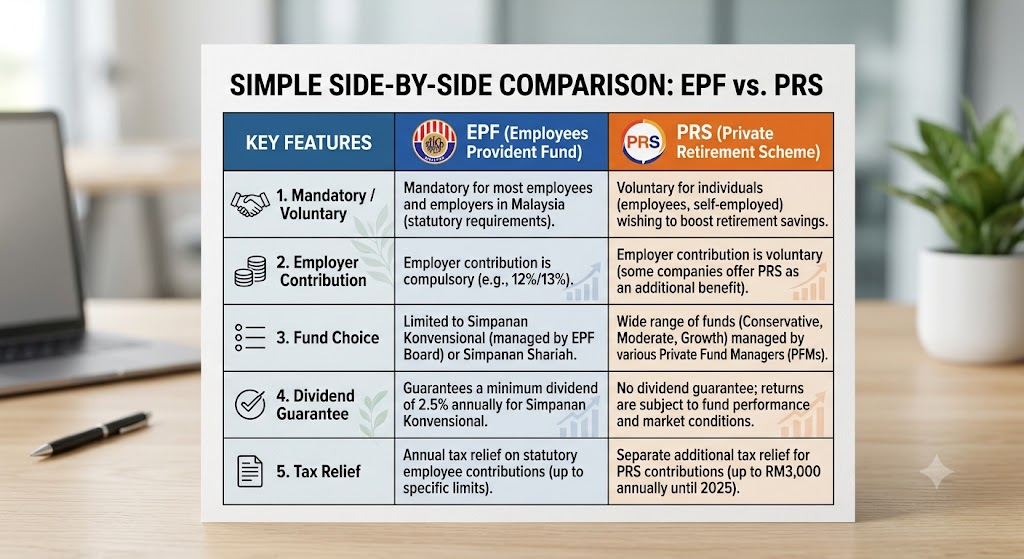
The Actual PRS vs EPF Malaysia Difference, Side by Side
- Mandatory vs voluntary: EPF is compulsory for salaried employees; PRS is entirely optional for anyone.
- Contribution source: EPF is funded by both employer and employee; PRS is typically self-funded unless your employer offers it as a benefit.
- Fund choice: EPF pools all contributions into one fund managed by EPF; PRS lets you choose your own provider and fund based on your risk profile.
- Returns: EPF declares an annual dividend with a statutory minimum guarantee; PRS returns are market-linked and not guaranteed.
- Tax relief: EPF contributions fall under the standard EPF/life insurance relief category; PRS contributions qualify for a separate, additional tax relief specifically for PRS — meaning topping up PRS can reduce your taxable income beyond what EPF alone already covers.
- Withdrawal flexibility: both restrict early withdrawal, though the specific conditions and exceptions differ between the two schemes.
Who Actually Benefits from Adding PRS on Top of EPF
Not everyone needs PRS. If you’re salaried, contributing consistently to EPF, and your retirement projections show you’re on track for the lifestyle you want, PRS is optional — a nice-to-have for additional tax relief and diversification, not a necessity.
PRS becomes genuinely valuable in a few specific situations:
- Self-employed or freelance income with no EPF contributions at all — PRS becomes your primary structured retirement vehicle rather than a supplement.
- EPF savings running behind retirement targets, whether from career gaps, late entry into formal employment, or simply higher retirement income goals than EPF alone will provide.
- Wanting exposure to growth-oriented funds beyond what EPF’s more conservative, pooled approach offers, for those with a longer time horizon and higher risk tolerance.
- Maximising annual tax relief — since PRS relief sits in a separate category from EPF/insurance relief, it’s genuinely additional tax savings, not a substitute.

What PRS Doesn’t Replace
PRS isn’t a substitute for EPF where EPF already applies to you — it’s an addition. Salaried employees should still prioritise consistent EPF contributions as the foundation, since EPF’s guaranteed dividend and mandatory employer contribution are advantages PRS simply doesn’t offer. PRS makes the most sense as a deliberate top-up once your EPF foundation is already solid, or as the primary vehicle specifically when EPF isn’t available to you at all.
Frequently Asked Questions
Can I withdraw from PRS before retirement age?
Early withdrawal is possible in some circumstances but typically comes with a tax penalty on the withdrawn amount, since PRS is designed for long-term retirement savings rather than short-term access.
Is PRS safer than EPF?
No — PRS returns are market-linked and not guaranteed, unlike EPF’s statutory minimum dividend. PRS carries genuine investment risk depending on the fund you choose, while EPF provides a guaranteed floor return.
How much PRS tax relief can I claim in Malaysia?
PRS contributions qualify for a separate annual tax relief category distinct from the standard EPF/life insurance relief, up to a specific yearly cap set by LHDN — check the current year’s exact figure, as relief limits can be revised.
Should self-employed people prioritise EPF or PRS?
Self-employed individuals can opt into EPF’s self-contribution scheme, but many find PRS’s flexibility around contribution amounts and fund choice better suited to variable income — the right answer depends on your specific cash flow and risk tolerance.
Not sure if your EPF alone is enough for retirement?
WhatsApp Keith Wong at +6016-336 9321 for a retirement readiness check, and find out whether PRS actually makes sense for your situation.
Disclaimer: This article is for general informational purposes only and does not constitute financial advice. PRS fund performance, EPF dividend rates, and tax relief limits change over time and vary by individual circumstance. Please consult your appointed Financial Adviser’s Representative or Licensed Financial Planner for guidance specific to your situation.