Most people size their life insurance by guesswork or a rough income multiple. Here’s the human life value method advisers actually use to get a real number.
By Keith Wong, FAR (BNM) · IFAR (BNM) · LFP (SC)
Table of Contents
Quick Answer: How much life insurance do I need Malaysia calculators and rules of thumb (like “10x your income”) only get you a rough estimate. The human life value method gets closer to a real number: it estimates the total future income you’d have earned and provided to your dependants until retirement, adjusted for your own living expenses, then nets off existing coverage and liquid assets. The result is usually more specific — and often larger — than a simple income multiple suggests.

How Much Life Insurance Do I Need Malaysia? Why “10x Income” Isn’t a Real Answer
The most common rule of thumb for how much life insurance do I need Malaysia readers come across is some multiple of annual income — 10x, 15x, sometimes higher. It’s easy to remember and easy to sell, but it ignores almost everything that actually matters: how many years until retirement, how many dependants rely on that income, what debts exist, and what assets are already in place to cushion the gap. Two people earning the same salary can have completely different real insurance needs, and a flat multiple treats them identically.
The human life value (HLV) method exists because of exactly this problem. Instead of a shortcut multiple, it works from your actual financial picture to estimate what your family would genuinely need to replace if your income stopped today.
The Human Life Value Method, Step by Step
1. Estimate future income you’d provide to dependants
Start with your current annual income, then project it forward to your expected retirement age, factoring in reasonable future salary growth. This is the raw income stream your family is financially depending on.
2. Subtract your own living expenses
Not all of your income supports your dependants — a portion covers your own personal spending. Subtract a reasonable estimate of your own expenses from the projected income, since that portion wouldn’t need replacing if you weren’t there.
3. Adjust for taxes and discount to present value
The remaining income stream should be adjusted for tax, then discounted back to a present-day lump sum using a reasonable discount rate — since a payout today needs to be smaller than the raw sum of future income, given that lump sum can itself earn a return over time.
4. Net off existing coverage and liquid assets
Finally, subtract any life insurance you already hold and liquid assets your family could realistically draw on (savings, EPF, other investments earmarked for this purpose). What’s left is the actual protection gap — the number a new or additional policy should be sized to cover.
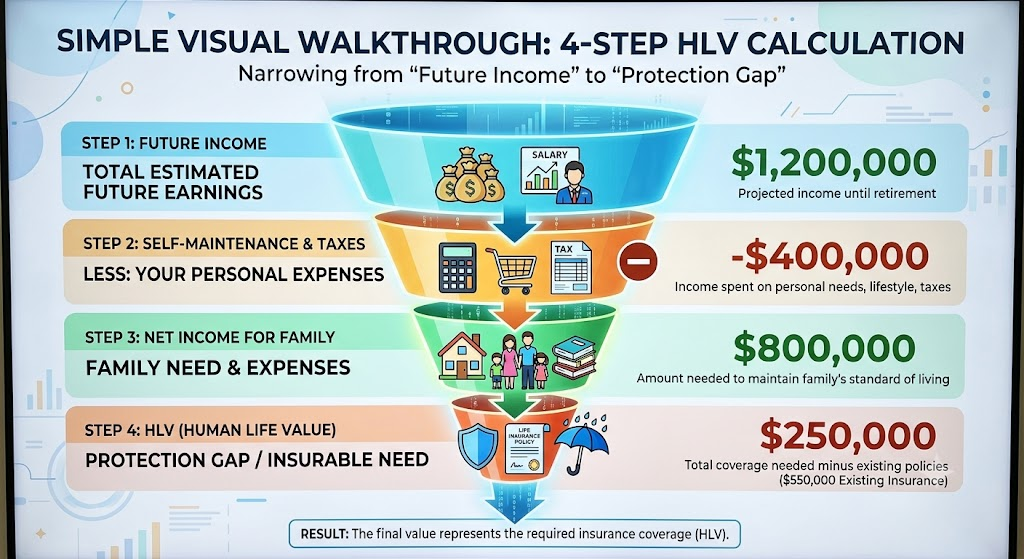
A Simplified Example
Someone earning RM8,000/month with 20 years to retirement might project roughly RM1.92 million in future income (before adjustments). After subtracting personal living expenses, taxes, and discounting to present value, that might reduce to somewhere in the RM900,000–RM1.1 million range. If they already hold RM300,000 in existing life coverage and have RM100,000 in liquid savings earmarked for the family, the real protection gap narrows to roughly RM500,000–RM700,000 — a specific, defensible number, not a guess.
The exact figures depend heavily on individual assumptions (discount rate, expense ratio, income growth), which is why this calculation is usually worked through with an adviser rather than estimated alone — small assumption changes can meaningfully shift the result.
Why This Matters More for the Self-Employed
For salaried employees, income multiples are already a rough approximation of a fairly predictable income stream. For self-employed individuals and business owners, income is often more variable, and there’s frequently no employer-provided group life coverage as a baseline — which makes an accurate, individually-calculated number even more important, not less. A flat multiple applied to a variable, business-linked income can be badly wrong in either direction.
This is also where business-linked liabilities come in. If you personally guarantee business loans, or your family would need to wind down or sell a business you run, those obligations should factor into the calculation on top of personal income replacement — another reason the human life value method tends to serve self-employed readers better than a generic multiple ever could.
Frequently Asked Questions
Is the human life value method more accurate than an income multiple?
Generally yes, since it accounts for your specific timeline to retirement, existing coverage, dependants, and expenses rather than applying a flat rule to everyone. It’s more work to calculate, but the result is more defensible and specific to your actual situation.
How much life insurance do I need if I’m self-employed?
The same human life value approach applies, though self-employed income projections need more care given income variability, and there’s usually no employer group life coverage to factor in as an existing baseline. This is often where the how much life insurance do I need Malaysia question matters most, since there’s no default employer safety net to fall back on.
Does the human life value method account for debts like a mortgage?
The core HLV calculation focuses on income replacement, but outstanding debts are typically added on top as a separate consideration, since a mortgage or other liability doesn’t disappear if income stops — many advisers include it as an explicit addition to the final number.
How often should I recalculate my life insurance need?
Whenever a major life change happens — a new child, a new mortgage, a significant income change, or getting closer to retirement — since each of these shifts the underlying numbers the calculation depends on.
Not sure what your actual number looks like?
WhatsApp Keith Wong at +6016-336 9321 and I’ll walk through the human life value calculation with your actual numbers.
Disclaimer: This article is for general informational purposes only and does not constitute financial advice. The human life value calculation depends on individual assumptions and circumstances. Please consult your appointed Financial Adviser’s Representative or Licensed Financial Planner for a calculation specific to your situation.