By Keith Wong, FAR (BNM) · IFAR (BNM) · LFP (SC)
A framework for weighing what breaking your lock-in costs against what refinancing actually saves.
Table of Contents
Quick Answer: The home loan refinance lock-in penalty in Malaysia usually runs 2-3% of your outstanding or original loan amount, charged if you settle or refinance within the first 3-5 years. It’s only worth paying if the interest you’ll save by refinancing over the remaining tenure is clearly bigger than the penalty plus your other switching costs — run the numbers before you sign anything.

Home loan refinance lock-in penalty Malaysia banks charge is the first number to check before you get excited about a lower rate somewhere else. Refinancing early can genuinely save you tens of thousands of ringgit in interest over the remaining tenure. It can also cost you a penalty that eats most of that saving in one lump sum, if you move before the lock-in period ends. The right decision isn’t “refinance now” or “wait it out” as a rule of thumb — it’s whatever the actual comparison tells you.
What Is the Home Loan Refinance Lock-In Penalty in Malaysia?
Most Malaysian housing loans come with a lock-in period of three to five years from the date your loan is disbursed. During that window, if you fully settle the loan — whether by refinancing to another bank, selling the property, or paying it off outright — the bank can charge an early settlement or redemption penalty. This is separate from the moving cost of refinancing itself; it’s the price for exiting the facility before the agreed term.
The exact figure isn’t standardised across the industry. It sits in your Letter of Offer and facility agreement, so two borrowers with loans from different banks — or even different packages from the same bank — can face very different numbers for what looks like the same situation.
Typical penalty structure
- Usually 2% to 3% of the outstanding loan balance (some packages calculate it on the original loan amount instead — check which one applies to you)
- Charged only if you settle or refinance within the lock-in period, which is commonly 3 to 5 years from disbursement
- Some banks have started waiving or discontinuing this fee on newer packages, so it’s worth asking directly rather than assuming the old norm still applies to your loan
- The penalty is unrelated to any moving-bank costs like valuation, legal, or stamping fees, which apply on top
When the lock-in period actually ends
Banks don’t all count from the same starting point. Some start the clock from your first disbursement (common for under-construction properties, where the loan is released in stages), others from full disbursement, and others from your first loan instalment. A few months’ difference in when you assume your lock-in ends can mean paying a penalty you didn’t need to. Ask your bank in writing for your exact lock-in end date once your loan is fully disbursed — don’t rely on a rough estimate from your loan agreement’s cover page.
The Real Question: Penalty Cost vs Interest Saved
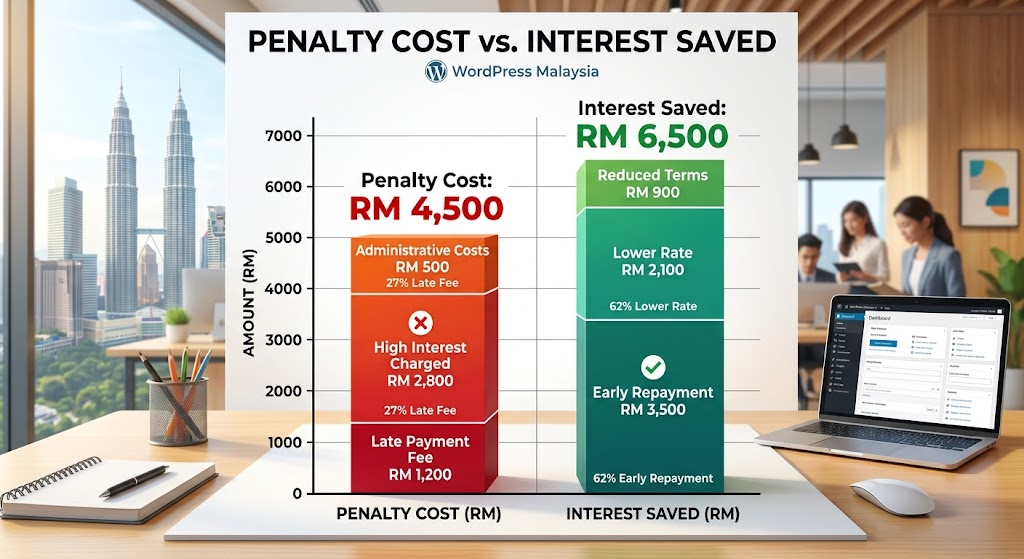
The decision to refinance during your lock-in period comes down to one comparison: is the penalty you’ll pay today smaller than the total interest you’ll save by switching to a lower rate over your remaining tenure? Everything else — how annoyed you are with your current bank, how attractive the new rate sounds — is noise next to that number.
Here’s the shape of the calculation, worked through with round numbers:
- Outstanding loan: RM450,000, with 20 years remaining at 4.5%
- New offer: same RM450,000 at 3.5%, refinanced today
- Lock-in penalty: 3% of RM450,000 = RM13,500
- Roughly monthly saving from the 1% rate cut: about RM280 to RM300 a month, depending on the exact amortisation schedule
- Break-even point: roughly 4 to 5 years before the cumulative monthly savings clear the RM13,500 penalty
If you’re planning to keep the property and the loan for well beyond that break-even point, refinancing despite the penalty usually still comes out ahead. If you expect to sell within the next few years anyway, the penalty may never fully pay for itself before you settle the loan through the sale.
Two other costs belong in the same comparison, not treated as afterthoughts: legal and stamping fees on the new facility (though some banks run zero-moving-cost campaigns that absorb these), and the valuation fee for the property. Add both to the penalty side before you compare against the interest saved.
When Breaking the Lock-In Is Worth It
- The rate gap is 0.5 percentage points or more, and you have well over half your tenure left to run
- You’re refinancing to unlock a longer tenure or a flexi/semi-flexi facility that materially improves your monthly cash flow, not just the headline rate
- Your bank has waived or reduced the early settlement fee on your specific package — always ask before assuming the standard 2-3% applies
- You’re consolidating high-interest debt into the refinanced amount and the blended saving clearly outweighs the penalty
When It’s Not Worth It Yet
- You’re within a year or two of your lock-in period ending anyway — waiting usually costs less than paying the penalty now
- The rate improvement is marginal (under 0.3 to 0.4 percentage points) and won’t clear the penalty within a reasonable number of years
- You expect to sell the property within the break-even window, so the loan will settle through the sale before the refinance pays for itself
- Your current facility already has flexi features you’d lose by switching, and the new package doesn’t replace that value
How to Run the Comparison Yourself
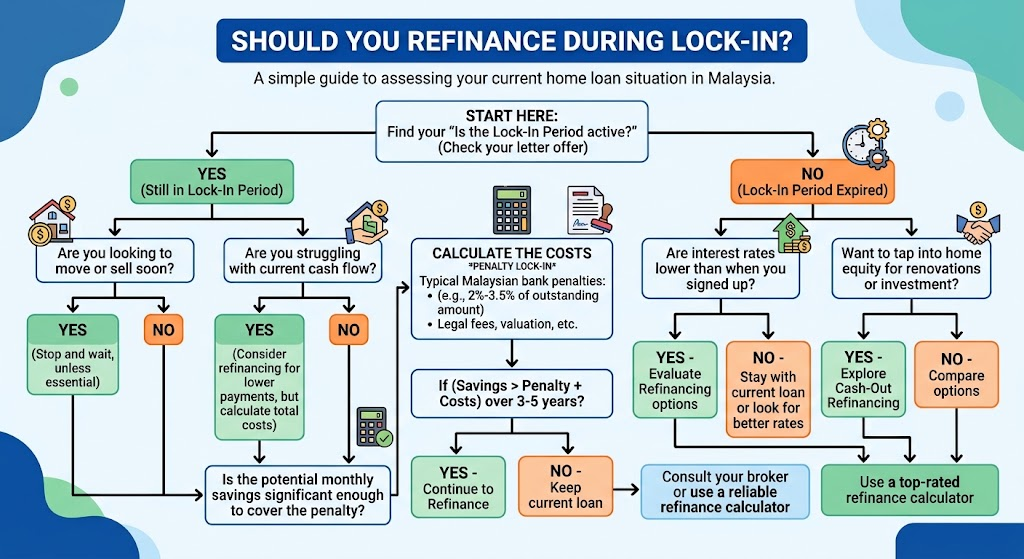
Before approaching a new bank, get two numbers in writing from your current lender: your exact outstanding balance and your lock-in end date. Then get a firm rate and package terms from the bank you’re considering — not just an indicative rate off their website. With those in hand, run both scenarios (stay vs refinance) over your actual remaining tenure, including the penalty and switching costs on the refinance side.
Our refinancing calculator is built for exactly this comparison — it lets you plug in your outstanding balance, current and new rates, remaining tenure, and the lock-in penalty, and shows you the break-even point and total savings side by side, rather than leaving you to estimate it.
If the numbers are close, or your loan has features like flexi withdrawal, EPF Account 2 support, or bundled insurance that complicate the comparison, it’s worth going through the figures with an adviser before signing a new Letter of Offer.
Frequently Asked Questions
Can I negotiate the lock-in penalty with my bank?
Sometimes. A few banks have discontinued or waived the early settlement fee on certain packages, and some are open to a discussion, especially if you’re a long-standing customer. It costs nothing to ask your relationship manager directly before assuming the standard rate applies.
Does the lock-in penalty apply if I sell the property instead of refinancing?
Yes. The penalty is tied to settling the loan early, not to the reason you’re settling it. Selling, refinancing, and paying off in cash all trigger the same clause if it happens within the lock-in period.
Is the penalty calculated on my original loan amount or my outstanding balance?
It depends on your facility agreement — this varies by bank and package, and the difference matters, since your outstanding balance is usually lower than what you originally borrowed. Check your Letter of Offer’s early settlement clause rather than assuming.
How long does refinancing itself take once I decide to proceed?
Budget for roughly 2 to 3 months from application to disbursement, including valuation, legal documentation, and discharge of the existing charge. Factor this timeline in if you’re timing the move around your lock-in end date.
Talk Through Your Numbers
If you want a second opinion before you commit to refinancing — or you just want someone to run the break-even math with you — message me on WhatsApp at +6016-336 9321. I work across a multi-provider panel, so the comparison isn’t limited to a single bank’s offer.
Disclaimer: This article is for general information only and does not constitute financial, legal, or investment advice. Lock-in periods, penalty rates, and refinancing terms vary by bank and by individual loan agreement — always confirm your specific figures with your bank in writing before making a decision. Keith Wong is a Financial Adviser’s Representative (FAR) and Islamic Financial Adviser’s Representative (IFAR) licensed under Bank Negara Malaysia, and a Licensed Financial Planner (LFP) under the Securities Commission Malaysia. Full credential details are available on the disclaimer page of this website.