By Keith Wong, FAR (BNM) · IFAR (BNM) · LFP (SC)
A fixed budget, employee-selected categories — how larger, more diverse workforces get benefits that actually fit.
Table of Contents
Quick Answer: Flexible benefits plan Malaysia corporate teams can budget for gives each employee a fixed allocation (flex credits, or a defined-category budget) to spend across benefit options like medical top-ups, dental, wellness, or family care — instead of every employee receiving the same fixed package. For large, diverse workforces it usually costs employers no more than a well-designed standard package, because the total budget is fixed up front; what changes is how each employee spends their share of it.

Flexible benefits plan Malaysia corporate teams are increasingly adopting isn’t a new concept, but it’s moved from a nice-to-have offered by a handful of MNCs to something mid-size and large local employers are actively scoping. The driver is simple: a 500-person workforce spanning fresh graduates, mid-career parents, and employees approaching retirement doesn’t have one shared set of needs. A single standard package — same medical limit, same dental allowance, same everything, for everyone — ends up over-providing for some employees and under-providing for others, while costing the same either way.
What Is a Flexible Benefits Plan in a Malaysian Corporate Setting?
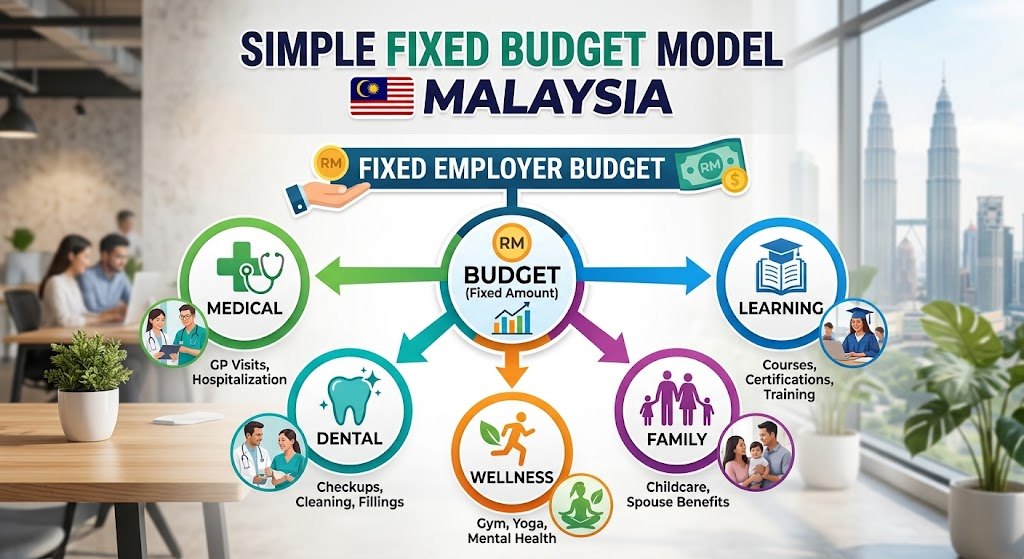
The structure is straightforward: the employer sets a total benefits budget per employee (or per job grade/tier), and instead of pre-deciding exactly how that budget is spent, employees choose how to allocate it across a defined list of categories. Some plans keep a small core of mandatory benefits — usually basic medical and life cover — and open up everything above that floor to employee choice. Others open the entire allocation, with mandatory statutory items like EPF and SOCSO sitting outside the flex structure entirely, since those aren’t optional under Malaysian law regardless of plan design.
The Two Structures Malaysian Employers Typically Use
Defined benefit categories with individual caps
The employer publishes a menu — say, Health & Wellness, Family Care, Professional Growth, Lifestyle — each with its own spending cap. An employee can put their full allocation toward extra medical and dental coverage, or split it between a gym subsidy and a professional certification. The caps prevent any one category from being over- or under-subscribed in a way that breaks the budget.
Flex wallet / lump-sum allocation
The employer gives each employee a single pool of flex credits (or ringgit value) with fewer restrictions on how it’s split across the approved category list. This gives employees more freedom but requires tighter administration — usually through a benefits platform or portal — to track spend and prevent one employee’s choices from creating unplanned claims exposure.
Why Larger Employers Are Moving Away from One-Size-Fits-All Packages
- A multi-generational workforce has genuinely different priorities — a 24-year-old and a 45-year-old parent rarely value the same benefit line the same way
- Retention and recruiting pressure: a flexible structure signals a modern, employee-first culture that’s become a differentiator in competitive hiring markets
- Budget predictability: because the total pool per employee is fixed, HR and finance get a known number to plan against, rather than open-ended claims growth on a rigid package
- Utilisation improves: benefits employees actually choose get used, versus a portion of a rigid package quietly going unclaimed every year
How to Structure a Flex Benefits Budget Without Overspending
The budget-setting step is where most of the financial risk sits, and it’s worth getting an adviser or broker involved before finalising numbers rather than after. A practical approach for larger employers:
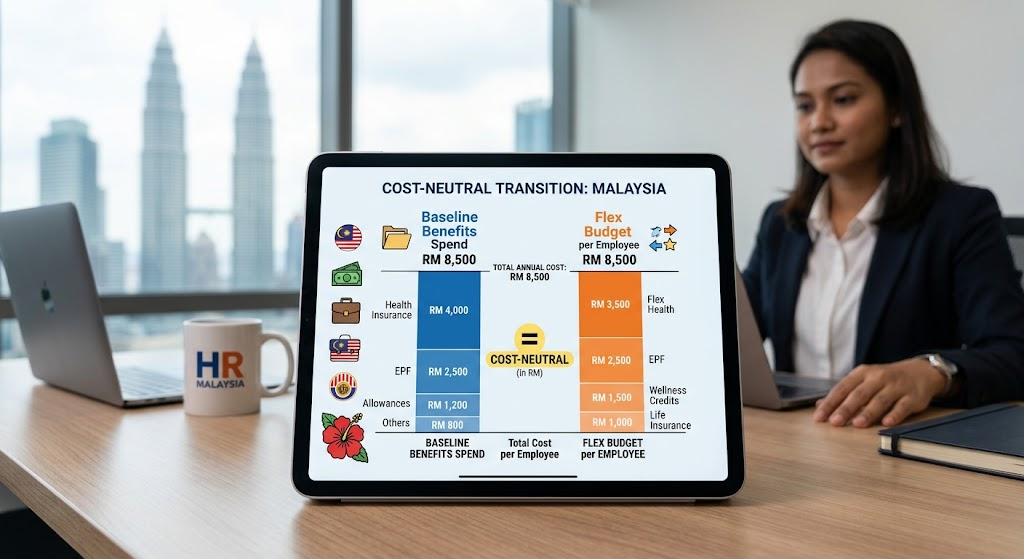
- Start from your current total benefits spend per employee (insurance premiums, allowances, and any ad hoc perks) as the baseline flex budget — this keeps the move to flex cost-neutral in year one
- Keep a small mandatory core (basic medical, group term life) outside the flex pool, since removing baseline protection entirely creates real risk for employees who under-allocate to health cover
- Set category caps for higher-cost items (major medical top-ups, dental) so claims experience stays within what your insurer priced the group policy on
- Review utilisation and claims data after the first full cycle before adjusting the total budget for the following year
What Belongs in the Category List
- Health & Wellness — medical top-ups, dental, vision, health screenings, gym or fitness subsidies
- Family Care — childcare support, elder care allowances, maternity/paternity top-ups
- Financial Wellness — voluntary PRS contributions, financial planning sessions, debt management support
- Professional Growth — certifications, courses, conference attendance
- Lifestyle — travel insurance, wellness apps, commuter allowances
Larger employers with a wide job-grade spread sometimes tier the total budget by grade while keeping the category list identical across all tiers — this preserves the sense of equal choice even where the underlying budget differs.
Rolling It Out: What HR Teams Should Plan For
The technical design is only half the project. Employees need a simple way to see their balance and make selections — most mid-size and large employers use a benefits administration platform rather than a manual spreadsheet process once headcount passes a few hundred. Communication matters just as much as the platform: run an open enrollment period with clear examples of how different employee profiles might allocate their budget, since a plan employees don’t understand gets under-utilised regardless of how well it’s designed.
It’s also worth reviewing your group insurance structure alongside the flex design. Some categories (major medical, group term life) sit better as a negotiated group policy that flex credits top up, rather than being purchased individually by each employee — this usually gives better pricing and avoids adverse selection within the group.
Frequently Asked Questions
Does a flexible benefits plan cost more than a standard package?
Not inherently. Because the total budget per employee is fixed and set by the employer, the cost is controlled at the design stage. What changes is allocation, not the total spend — assuming the budget is set sensibly against your current baseline.
Can EPF and SOCSO be part of the flex allocation?
No. Statutory contributions like EPF, SOCSO, and EIS are mandatory under Malaysian law and sit outside any flex structure — flex benefits only apply to the discretionary layer above statutory and core protection.
Is a flexible benefits plan practical for a smaller company?
It’s more commonly adopted by larger employers because the administration overhead is easier to justify at scale, and a bigger, more diverse headcount gets more value from choice. Smaller companies can still do a simplified version, usually with fewer categories and a lighter administration approach.
How often should the flex budget be reviewed?
Annually, alongside your group insurance renewal. Reviewing utilisation and claims data each cycle lets you adjust category caps or the total budget before costs drift from what was originally planned.
Talk Through Your Employee Benefits Structure
If you’re scoping a flex benefits structure for your organisation — or reviewing whether your current group insurance and benefits setup still fits your workforce — message me on WhatsApp at +6016-336 9321. I work across a multi-provider panel, so the design isn’t limited to one insurer’s standard template.
Disclaimer: This article is for general information only and does not constitute financial, legal, insurance, or HR advisory advice. Flexible benefits plan design, budget adequacy, and insurer pricing vary by workforce profile and should be confirmed with a licensed adviser and your insurer before implementation. Keith Wong is a Financial Adviser’s Representative (FAR) and Islamic Financial Adviser’s Representative (IFAR) licensed under Bank Negara Malaysia, and a Licensed Financial Planner (LFP) under the Securities Commission Malaysia. Full credential details are available on the disclaimer page of this website.