By Keith Wong, FAR (BNM) · IFAR (BNM) · LFP (SC)
Your medical card premium keeps climbing even though you haven’t claimed a single ringgit this year. Here’s what’s actually driving it — and what you can do about it.
Table of Contents
Medical inflation Malaysia insurance premium increases are driven mainly by rising healthcare costs, not insurer profit-taking. Malaysia’s medical inflation is projected to hit around 16% in 2026 — more than five times general inflation — and Bank Negara Malaysia now caps annual premium hikes at 10%, spread over a minimum of three years. Even if you never make a claim, your premium still rises, because insurers price the entire risk pool you belong to, not your personal claims history.
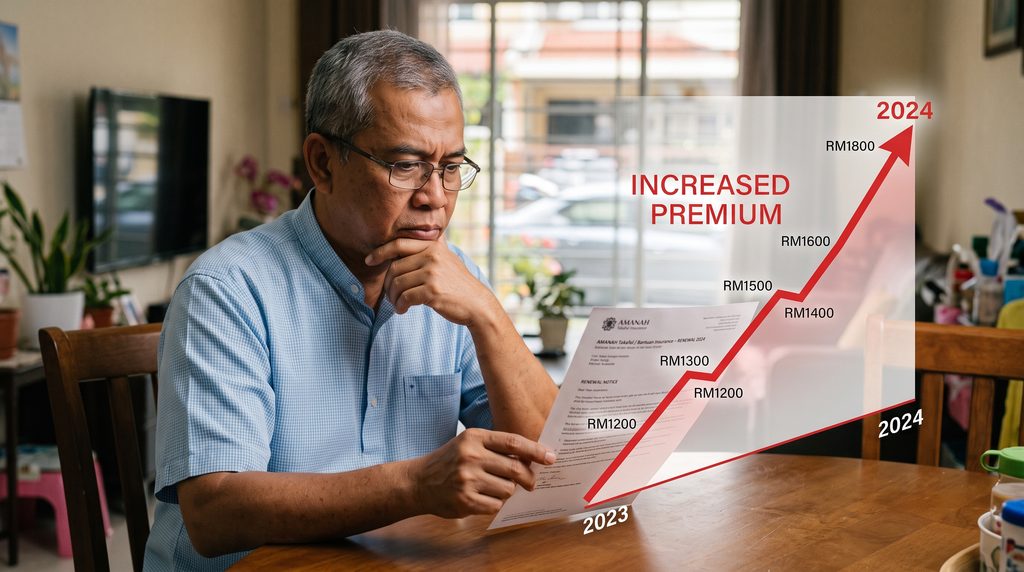
Renewal notice just landed, and the number is higher again — even though you haven’t stepped into a hospital all year? You’re not imagining it, and it isn’t necessarily your insurer being unfair to you specifically. It’s a nationwide trend that’s been building for several years, and 2026 is shaping up to be one of the steepest yet.
What “Medical Inflation” Actually Means
Medical inflation measures how fast the cost of treatment, hospital stays, medicine and medical technology rises each year — and it moves quite differently from Malaysia’s general Consumer Price Index (CPI), which tracks everyday costs like food, fuel and rent.
While CPI has generally sat in the low single digits, medical inflation in Malaysia has been running far hotter. Industry reports put it at around 15% for 2024 and 2025, with a widely cited 2026 Global Medical Trend Rates Report projecting it will climb to roughly 16% in 2026 — among the highest in the ASEAN region, trailing only Indonesia, and well above the broader Asia-Pacific average of around 11%.
That gap compounds year after year. A procedure that costs RM10,000 today could realistically cost close to RM18,000–RM20,000 within five years if the trend holds — and your medical card premium is priced to keep pace with that trajectory, not with what you personally spent.
Why Malaysia’s Medical Inflation Is Running So Hot
A few factors are compounding at the same time:
- Hospital and treatment costs are rising fast. Private hospital charges in Malaysia aren’t tightly price-regulated, so costs can climb with little restraint, and newer treatments and technology cost more to deliver.
- Utilisation is climbing. As more Malaysians own medical cards, more people use them — once you’re covered, you’re more likely to seek treatment rather than delay it, which pushes up claims volume across the whole industry.
- Medicine costs have jumped sharply. Some medicine prices have reportedly risen by 30–40% in recent times.
- The population is aging. As Malaysia’s demographic profile shifts older, the pool of policyholders needing more frequent and more expensive care keeps growing.
- Claims are outpacing premiums. The industry paid out roughly RM9.4 billion in medical claims in 2025, up 5.3% from the year before, with medical claims making up more than half of total industry claims — meaning insurers have been absorbing losses on medical portfolios for several years before repricing catches up.
How Bank Negara Malaysia Stepped In to Slow the Shocks
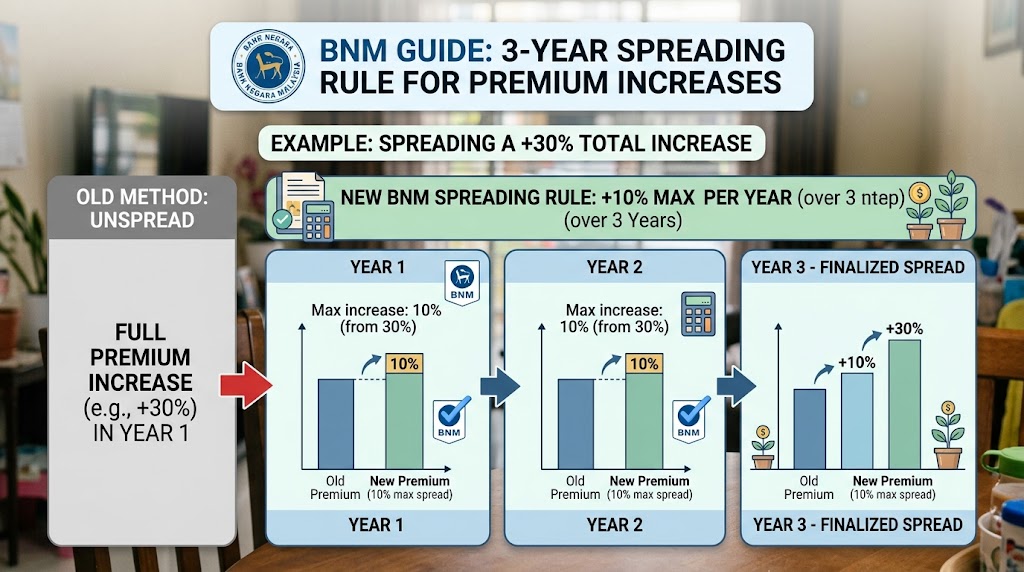
The sharp premium jumps of recent years drew enough public concern that Bank Negara Malaysia (BNM) intervened directly. Insurers and takaful operators were directed to spread out premium increases over a minimum of three years, capping any single annual hike at 10%, rather than applying one large adjustment in a single renewal.
BNM also ruled that policyholders above age 60 would see no premium increase in 2025, with any adjustment only taking effect after their 2026 policy anniversary. Budget 2026 added a further layer of support: a RM60 million joint government–industry fund aimed at launching more affordable basic medical insurance products for Malaysians priced out of standard plans.
Why Your Premium Still Rises Even If You Never Claimed
This is the part that catches people off guard. Health insurance doesn’t price you as an individual — it prices the entire pool of policyholders on your plan type. Every ringgit an insurer pays out to other policyholders on your plan — for a bypass surgery, cancer treatment, or a long ICU stay — gets factored into what everyone in that risk pool pays going forward. Your own clean claims history doesn’t exempt you from an industry-wide repricing.
On top of pool-wide inflation, most plans also apply age-band pricing, so your premium steps up further as you move into a new age bracket, regardless of whether you’ve ever made a claim. So when your renewal comes in higher, it’s less “we’ve decided to charge you more” and more “healthcare across Malaysia got more expensive, and everyone on this plan is absorbing that together.”
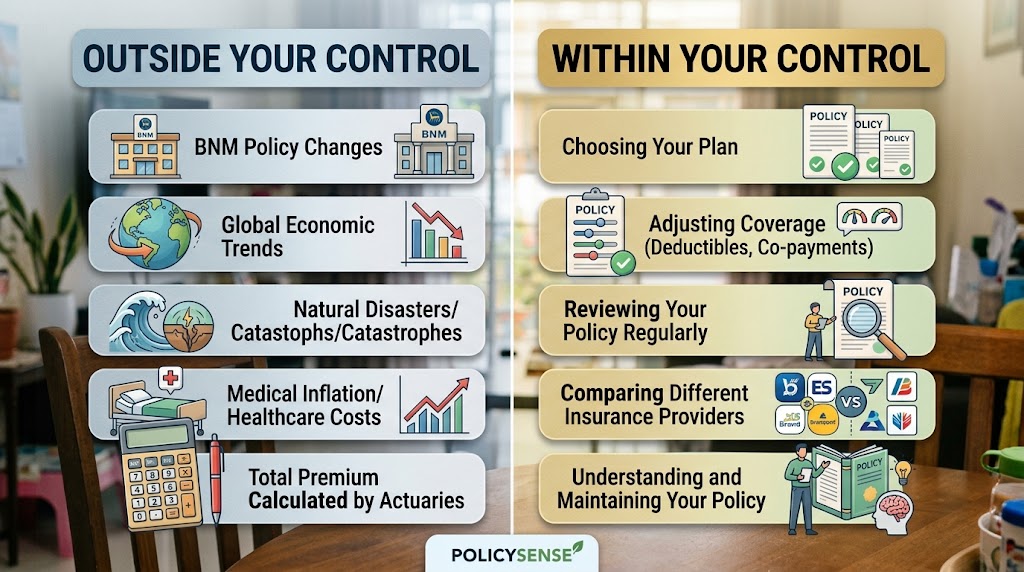
What You Can — and Can’t — Control at Renewal
Outside your control
- Private hospital pricing and how fast treatment costs rise nationally
- How much other policyholders in your risk pool claim in a given year
- Regulatory changes like the BNM premium cap — helpful, but not something you influence directly
Within your control
- How your plan is structured — a deductible or co-insurance option can meaningfully lower your premium in exchange for sharing a small part of the cost yourself
- Whether you’re paying twice — reviewing what your employer’s group cover already provides before buying an identical individual plan on top of it
- Comparing providers and plan designs at renewal, rather than letting it auto-renew unchecked
- Buying earlier rather than later — every year you delay typically adds another 5–10% to your entry premium, on top of medical inflation itself
- Preventive habits — regular health screening and catching issues early tends to be far cheaper than late-stage treatment, and some insurers reward it
Frequently Asked Questions
Will medical inflation in Malaysia stay this high?
Recent industry reports project medical inflation to keep climbing through 2026, though reforms — the DRG (diagnosis-related group) hospital payment model, the BNM premium cap, and a proposed low-cost base medical plan — are aimed at slowing it in future years. Whether they bring rates down meaningfully will depend on how quickly they’re implemented.
Does BNM’s 10% cap mean my premium can never rise by more than 10%?
In any single year, yes — insurers must spread larger increases across a minimum of three years rather than applying them all at once. Over that same three-year window, though, the cumulative increase can still be substantial.
Should I downgrade my plan to avoid the increase?
Not automatically. A lower annual limit or higher deductible can lower your premium, but it also shifts more cost to you if something serious happens. It’s worth reviewing that trade-off against your actual savings and emergency fund, rather than downgrading purely to avoid a renewal shock.
Is switching insurers at renewal a good way to cut costs?
Sometimes — but be careful. Switching usually means fresh medical underwriting, and any condition you’ve developed since your original policy, even something minor, could become a pre-existing exclusion on a new plan. It’s often worth a proper comparison before assuming a switch saves money.
If your renewal notice has you wondering whether your medical card still fits your needs and your budget, I can walk through it with you — no pressure, no obligation.
WhatsApp me at +6016-336 9321 and we’ll figure out what actually makes sense for your situation.
This article is for general information only and does not constitute financial, insurance or medical advice. Product terms, pricing and availability vary by insurer and are subject to change. Please consult a licensed financial adviser before making any insurance decisions.